Who Actually Has to Retrofit in LA — and What It Costs in 2026
Christina Kim · 20 Jul 2026 · 6 min read
Every few years an earthquake reminds Southern California that its housing stock was mostly built before anyone knew better, and for about three weeks afterward contractors can't answer their phones. Then it goes quiet again.
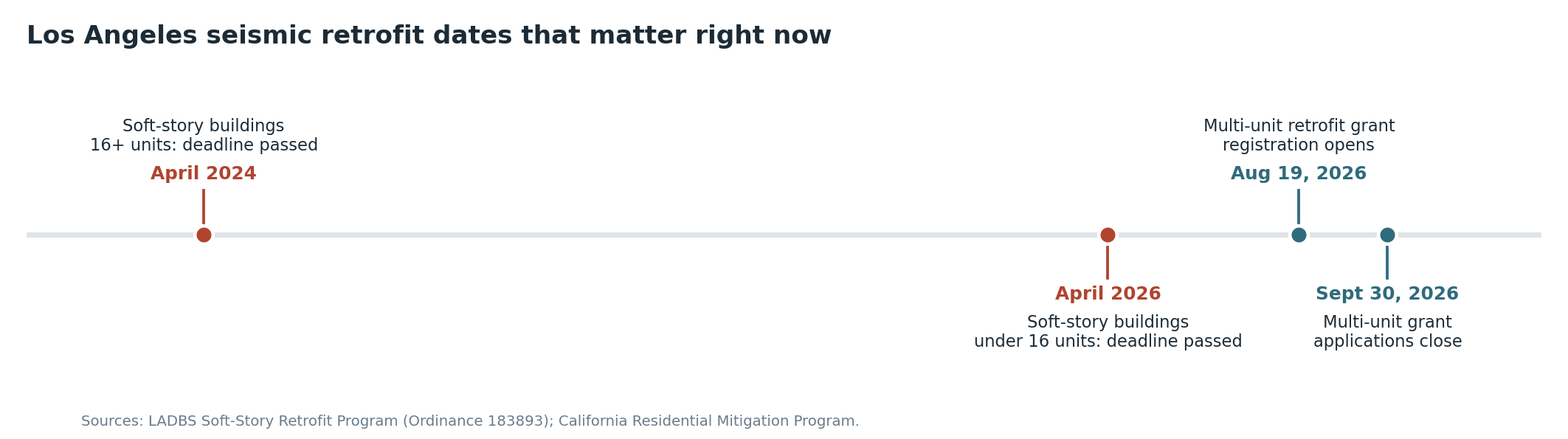
There is a better time to deal with this than the three weeks after. Two grant windows open in the next several weeks, one of them on August 19. If you own an older building here, this is the month to sort out which category you fall into.
First: are you required to, or not?
This is where most of the confusion lives. Los Angeles has two entirely separate situations, and people routinely apply the rules from one to the other.
If you own a wood-frame multifamily building with a soft story, you are under a mandate. Ordinance 183893 covers roughly 13,500 buildings across the city — the most ambitious mandatory seismic retrofit program in the country. "Soft story" means a weak ground floor, typically because it's mostly tuck-under parking or storefront glass with not enough wall to resist lateral movement. If your building has apartments sitting over open parking, you probably know already, because the city mailed you an order.
The compliance clock ran on a seven-year schedule from notification. Buildings of 16 or more units were required to complete construction by April 2024. Smaller buildings — under 16 units — hit their deadline in April 2026. That date has passed. Owners still outstanding face daily fines, restricted certificates of occupancy, and in extended cases condemnation proceedings. If you're in that group, the exposure grows every month and the path back is through LADBS, not through waiting.
Non-ductile concrete buildings are also covered under the city's mandatory retrofit programs, on a much longer compliance timeline running to 2040. Different animal, different engineering, different budget.
If you own a single-family house, nothing requires you to retrofit. No ordinance, no deadline, no fine. The decision is entirely yours, which is precisely why so few people make it.
The single-family question
Whether it's worth doing comes down to one thing: what your house sits on.
The homes at real risk are pre-1980 with a raised foundation and a crawlspace — meaning there's a short wood wall, called a cripple wall, between the concrete foundation and the floor framing. In a strong shake, an unbraced cripple wall racks sideways and the house slides off its foundation. That's not a crack you patch. That's frequently a total loss, and unbraced cripple walls have been a leading cause of residential damage in past California earthquakes.
Two questions will tell you most of what you need to know:
- Can you get into a crawlspace under your floor? (If your house sits on a concrete slab, this generally doesn't apply to you.)
- Down there, are there steel anchor bolts connecting the wood sill plate to the concrete, and is the cripple wall sheathed in plywood?
If the answer to the first is yes and the second is no, you have an unretrofitted house. Most pre-war LA bungalows are in exactly this condition.
What it actually costs
Numbers below reflect current Los Angeles-area pricing. Every house is different, and anyone quoting you before crawling under it is guessing.
Work · Typical LA cost
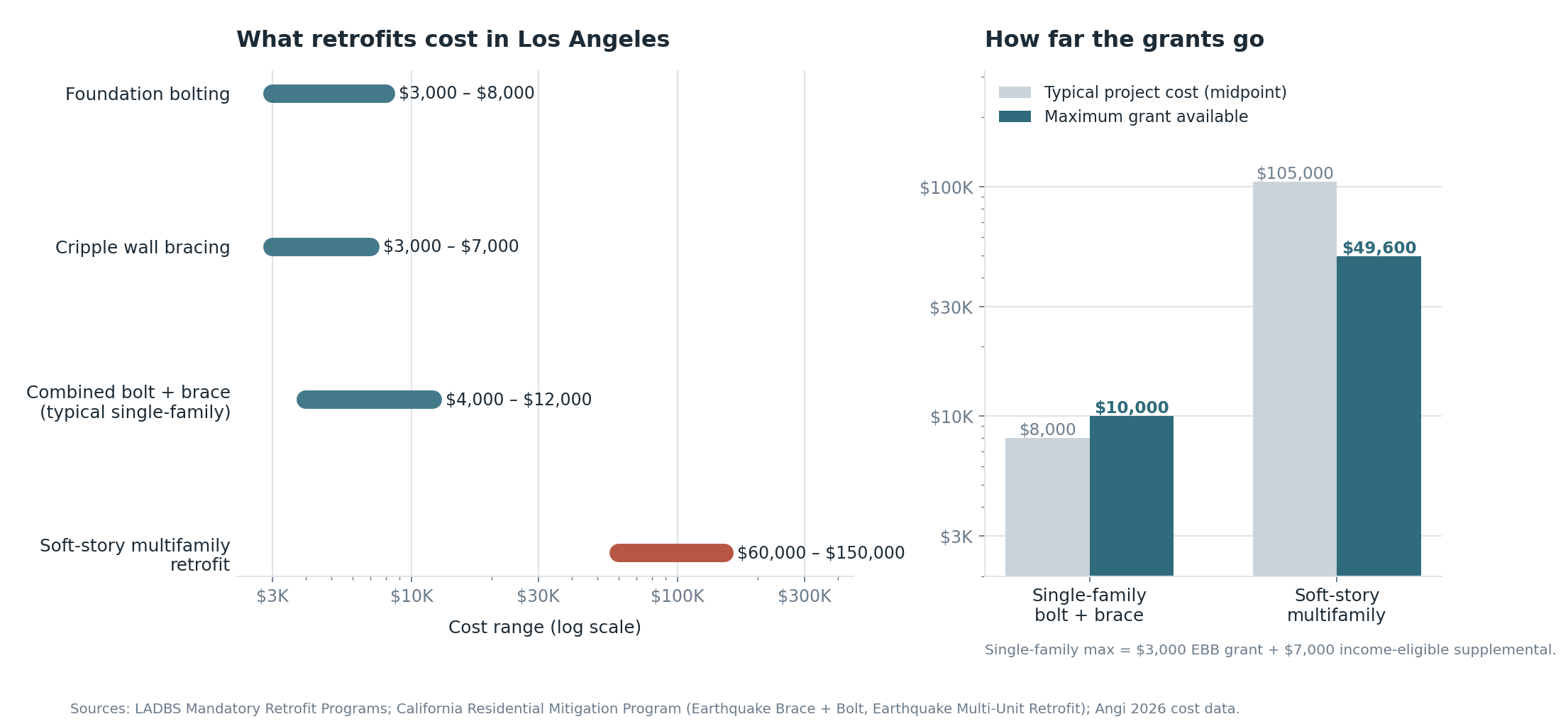
- Foundation bolting (anchor bolts to sill plate) — $3,000 – $8,000
- Cripple wall bracing (plywood sheathing) — $3,000 – $7,000
- Combined bolt-and-brace, standard single-family — $4,000 – $12,000
- Soft-story multifamily retrofit — $60,000 – $150,000
Rough rule of thumb on the residential side: $3 to $7 per square foot, driven mostly by crawlspace height, perimeter length, and access. A house with an 18-inch crawlspace costs more than one you can walk under, because everything gets done lying down.
The soft-story range is wide for good reason. A steel moment frame at the parking opening, foundation work to support it, and the associated engineering and permitting vary enormously by building geometry. Get three bids from contractors who have completed LADBS soft-story work specifically.
The grants are real, and two windows are open
Single-family — Earthquake Brace + Bolt. The California Residential Mitigation Program offers up to $3,000 toward a code-compliant brace-and-bolt retrofit. Households earning $94,480 or less annually can apply for a supplemental grant of up to $7,000 on top of that. For a straightforward project, those two combined can cover essentially the entire cost.
Registration windows have generally opened in the fall, and the program is not first-come-forever — it's a registration period followed by selection. The practical move today is to create an account at earthquakebracebolt.com and turn on email notifications so you don't find out three days after it closed.
Multifamily — Earthquake Multi-Unit Retrofit. This is the one with a hard date. Registration opens August 19, 2026, with applications accepted through September 30, 2026, and eligible owners can receive up to $49,600 toward a mandated soft-story retrofit. Against a $60,000-to-$150,000 project, that's not a rounding error. If you own a soft-story building in Los Angeles, put August 19 in your calendar now.
The part people forget: your insurance
A completed, code-compliant retrofit can qualify a house for up to a 25% discount on California Earthquake Authority premiums. CEA policies are the primary earthquake coverage in this state, and 25% off compounds annually for as long as you own the house.
Run the arithmetic on your own policy before you decide the retrofit is too expensive. Between the grant on the front end and the premium reduction on the back, the net cost of a brace-and-bolt job is often a fraction of the sticker.
Worth saying clearly, though: earthquake coverage is separate from your homeowners policy and you have to buy it deliberately. A retrofit protects the structure. It does nothing for you financially if you have no earthquake coverage at all, and most California homeowners don't.
What it does at resale
I'll be honest about this, because the topic invites overstatement.
A retrofit is not a kitchen. It won't return its cost in a higher sale price, and buyers rarely pay a premium for one. What it does is remove an objection. In a market where inventory has loosened and buyers have room to be picky, a documented retrofit with permits and a final inspection is one fewer reason for someone to negotiate against you or walk during their inspection contingency. Keep the permit records. They're worth more in a file than the work is worth in a listing description.
For soft-story multifamily, the calculus is different and much sharper. An unretrofitted building past its deadline is a serious problem in a sale — it affects financing, it affects what buyers will pay, and it transfers the city's enforcement exposure to whoever buys it. Compliance isn't an upgrade there. It's a prerequisite.
If you do one thing this week
Get under your house with a flashlight and look for anchor bolts. It takes ten minutes and it tells you which conversation you're actually having.
If you own a soft-story building, the date is August 19.
Not sure which category your property falls into? Send me the address and the year built and I'll tell you what I can find.




Thinking about a move in LA?
Whether you're buying, selling, or just curious what your home is worth — start with a conversation. No pressure, no obligation.
Book a consultation